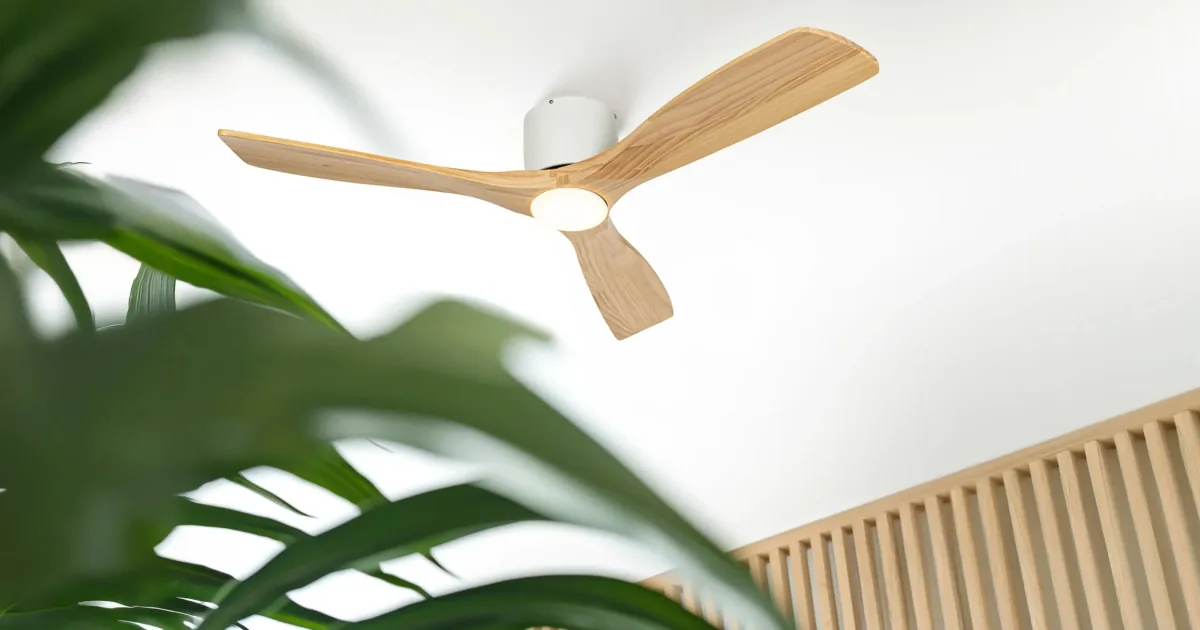
A wooden blade ceiling fan is the one type of fan that does not look like an appliance. That is most of the reason people buy one. The rest of the decision is less obvious: blade span has to match the room, the motor decides how loud it is, and wood behaves badly in damp air in a way plastic does not.
This guide covers what you are actually choosing between, in the order the choices matter: whether the blades are solid wood or veneer, what size to buy, how many blades, light or no light, which finish, and which motor. It ends with the rooms where a wooden fan is the wrong purchase.
Worth saying up front: we sell wooden blade ceiling fans, so read this as informed but interested. The figures below come from manufacturer specifications, our own product data, and published guidance from ENERGY STAR and the US EPA. We have not run our own airflow tests. Where wood is the wrong material, this guide says so and points at the fans in our range that are not wood.
Are Wooden Ceiling Fans Good?
Short answer: yes, for normal indoor rooms. They suit a room that already has timber in it, they run smoothly and quietly on a DC motor, and the motor warranties on ours run from 2 to 10 years. They are a poor choice for bathrooms, uncovered patios, and any room that stays humid, because wood absorbs moisture and warps.
The trade-offs:
| In favour | Against |
|---|---|
| Looks like furniture, not an appliance | Warps and can crack in sustained damp air |
| Natural grain means no two blades match exactly | Heavier, so balance and mounting matter more |
| Runs quietly on a DC motor | Needs re-sealing every year or two in a humid room |
| Long service life; the WILMA motor is covered for 10 years | Slightly less air movement than a metal blade of the same span |
The airflow gap is real but small, and it is usually swamped by blade span and motor quality. A well-sized 132 cm wooden fan moves more air than an undersized 107 cm metal one. Size first, material second.
Wood is not automatically the expensive option either. In our range the 10-blade wooden fan and the 12-blade ABS fan are the same price, and the cheapest fan we stock is the aluminium outdoor one.
If you want the material argument in full, our steel vs wood vs plastic blade comparison sets the three side by side. This guide assumes you have already decided on wood.
Solid Wood, Plywood or Wood-Look: What a "Wooden Blade" Actually Means

"Wooden" covers three different things on a spec sheet, and the price gap between them is large. Check which one you are buying before anything else.
- Solid wood. Cut from one piece of timber. Best grain, quietest, heaviest, most expensive. Also the most sensitive to humidity, because there is nothing in the construction fighting the movement.
- Plywood or laminated veneer. Thin sheets of real wood bonded with the grain running in opposing directions. That cross-grain layup is what resists warping, so a laminated blade is genuinely more stable in a humid room than a solid one. Lighter and cheaper, with a less distinctive grain.
- Wood-look. ABS plastic with a printed timber finish. Not wood at all. Immune to humidity, cheapest, and it looks like what it is once you are standing under it.
The first two are both legitimate buys, but they are not the same product. A listing that says "timber finish" rather than "solid wood" is usually telling you it is the third kind. If the specification does not name the construction, treat it as wood-look.
Applying that rule to our own range: most of the fans here have solid wood blades. Three do not, and each is deliberate. The 10-blade windmill fan uses plywood in a barnwood finish, which is the right construction for a blade that long, for the cross-grain reason above. The 12-blade farmhouse fan uses sculpted ABS and the waterproof outdoor fan uses aluminium; both are covered in the damp-rooms section below.
What Size Wooden Ceiling Fan Do You Need?
Blade span is measured tip to tip across the full circle, and it is the single number that decides whether the fan works. Undersized fans are the most common mistake: the fan runs and the air in the room barely moves.
Measure the floor area, then match it:
| Room size | Blade span | Typical room |
|---|---|---|
| Up to 7 m² | 36 in (91 cm) | Small bedroom, study, hallway |
| 7 to 16 m² | 42 to 48 in (107 to 122 cm) | Bedroom, home office |
| 16 to 32 m² | 52 in (132 cm) | Living room, dining room |
| 32 to 37 m² | 60 in (152 cm) | Large living room, open kitchen |
| Over 37 m² | 65 to 70 in (165 to 177 cm) | Open-plan space, loft, vaulted room |
Height and clearance. ENERGY STAR puts the blades at least 2.1 m (7 ft) above the floor and 45 cm (18 in) clear of the walls, and recommends 2.4 to 2.7 m (8 to 9 ft) above the floor where the ceiling allows it. Under a 2.4 m ceiling, use the shortest downrod in the box or a flush mount. Above 2.7 m, a longer downrod brings the blades down into the part of the room you actually occupy.
Two fans beat one oversized fan in a long room. A 7 m by 4 m open-plan space is better served by two 132 cm fans than a single 177 cm one, because the airflow reaches both ends.
How our range maps onto this. The smallest span we stock is 36 in, on the SARAH, which is the one to look at for a room under 7 m². The KARST comes in 42 in (107 cm), 52 in (132 cm) and 60 in (152 cm) and is rated for rooms from 15 to 55 m². The BALO platform runs the widest ladder, 42 in (106 cm) through 70 in (177 cm). The WILMA covers the large end at 52 in and 64 in. See the full wooden blade ceiling fan range for what is in stock.
How Many Blades? Three Versus Ten

Blade count changes the character of the fan more than its cooling power. Most wooden fans have three blades, and there is a mechanical reason for it.
Three blades is the standard because wood is heavy. Fewer blades mean less mass on the motor, less drag and higher speed for the same power draw. Three solid wood blades on a DC motor is the configuration that gets you quiet running and strong airflow in the middle of the price range. It also reads as modern rather than traditional.
Ten or twelve blades is a windmill look. More blades move air more gently and more evenly, at lower rotational speed, which is why the style suits large open rooms where a fast three-blade fan would feel gusty. The cost is a heavier assembly, a bigger motor, and a higher price.
Neither wins on cooling in the abstract. Airflow is set by blade span, blade pitch and motor speed together, not by counting blades. Our 12-blade versus 3-blade comparison works through the airflow numbers if you want the detail.
In practice: pick three blades for a bedroom or a normal living room, and a multi-blade fan only if the room is large and the windmill look is what you are after. Our Smart Wood 10-blade is 165 cm across with a DC motor, and its blades are plywood in a barnwood finish rather than solid timber, which is the sensible construction at that span.
With a Light or Without
This one depends entirely on what else is in the ceiling, and it is worth deciding before you shop rather than after.
Buy the version with a light if the fan is going where the room's only ceiling fitting is. You get one point of control and no second hole in the ceiling. Look for an integrated LED with selectable colour temperature: warm light for a bedroom, neutral for a kitchen. Our MARA has three colour temperatures across 42, 48 and 52 in sizes, and the GINO adds a memory function so it returns to the last setting rather than resetting to cold white every time.
Buy the version without a light if the room already has lighting you like. A fan with a redundant light kit is a worse-looking fan, and a bare ceiling fan reads as much cleaner. This is the right choice in a room lit with lamps and pendants, which is how we would light a living room anyway. Our SARAH covers 36 to 60 in without a light kit, and the WILMA does the same at 52 and 64 in.
If you are going without a fan light, the room needs a proper scheme rather than one bulb. Our living room lighting guide covers building it in layers.
Check the downrod either way. A light kit adds height. The GINO ships with 10 cm and 20 cm downrods so you can set the drop to the ceiling, which counts for more once a light housing hangs below the motor.
Which Wood Finish: Natural, Dark, White or Black
Finish is the decision people spend longest on and regret most often. The rule that works: match the fan to the largest wood surface already in the room, or go to a neutral and stop trying to match at all.
- Natural and light timber. The safest choice in a room with oak or ash floors, and the one that suits Japandi and Scandinavian rooms. It disappears against a white ceiling, which is usually what you want from a fan.
- Mid and dark brown. Works with walnut furniture and warmer palettes, and gives the fan more presence. Dark blades against a white ceiling are a deliberate contrast, so choose it because you want the fan noticed.
- White. The disappearing option. Against a white ceiling a white fan is close to invisible from below, which is the point in a small room or a low one.
- Black. Reads as a fixture rather than furniture, and holds up in a room with black window frames or dark metal.
One practical note: dark and matte finishes show dust sooner than natural timber, and white shows it least. If the fan is going somewhere you will not reach easily, that will bother you more than it sounds.
The same three-blade platform in our range comes in light brown, brown, white and black, all at 42 to 70 in, so you can pick the finish without changing the specification.
DC or AC: The Motor Matters More Than the Blades
If you compare two wooden fans and only one number is available, make it the motor type. It decides noise, running cost and how much control you get.
DC motors are quieter, because they run with less vibration and friction than AC motors, and they draw substantially less power. Manufacturers of the 10-blade model in our range put the saving at up to 75% against an equivalent AC fan. DC also gives you more speeds, usually six, and a proper reverse function.
AC motors are cheaper and perfectly serviceable, with fewer speeds and more audible hum. They are the sensible choice where the fan is outdoors or in a utility space and quietness is not the priority. Our waterproof outdoor model uses one for exactly that reason.
Three motor-related features worth having on an indoor wooden fan:
- Reverse. Anticlockwise in summer pushes air down and cools you. Clockwise at low speed in winter pulls air up and pushes the warm layer at the ceiling back down the walls, which is a real saving in a room with high ceilings.
- A timer. One, four and eight hour options are standard on the KARST and the BALO platform. In a bedroom, a fan that stops itself at 04:00 is the difference between sleeping through and waking up cold.
- Remote or app control. A remote is the baseline. The 10-blade model adds WiFi through Smart by Bond, so it works with Amazon Alexa and Google Home if you already run one of those.
On warranties. Motor cover is the number that tells you what the manufacturer expects. The WILMA carries a 10-year motor warranty, the SARAH and the waterproof model 3 years, and the BALO platform 2 years with a stated average motor life of 15 years. A long motor warranty on a cheap fan is a better signal than a long list of features.
Where Wood Is the Wrong Choice: Bathrooms, Open Patios and Damp Rooms
Wood is porous. It takes moisture out of humid air, swells unevenly, and the blade warps and drops. Once one blade has moved, the fan is out of balance and it wobbles and gets noisy. This is not a defect you can fix by tightening the mounting.
The safe range. The US EPA recommends keeping indoor relative humidity between 30 and 50%, which is also the band wood products are stable in. A normal heated and ventilated room sits inside it, and a wooden fan is fine there indefinitely. Somewhere that sits above 50% for weeks at a time is a different question.
Do not put a solid wood fan in: a bathroom or wet room, an uncovered patio or balcony, a conservatory that swings between hot and damp, or an unheated space that goes through condensation cycles. A covered porch with real shelter is usually acceptable, and a laminated or cross-grain blade handles it better than a solid one.
What to buy instead. For a genuinely damp or outdoor spot, buy the material that does not care. Our waterproof ceiling fan is aluminium and iron with an AC motor, rated for patios, terraces, balconies and gazebos, at 42 in (106 cm) and 52 in (132 cm). The 12-blade farmhouse fan uses sculpted ABS blades rather than wood and is rated for covered outdoor locations, at 165 cm with a 20° blade pitch and 8848 CFM of airflow.
If you are choosing a fan for a hot room rather than a damp one, our hot climate fan guide goes through the features that matter there.
Care, Lifespan and What You Should Pay
Cleaning. Dust the blades every few weeks and clean them properly about every three months. The pillowcase method is the one that works: slide an old pillowcase over each blade, close it round, and pull it back towards you so the dust falls inside instead of over the room. For grime, use a barely damp microfibre cloth with mild detergent or diluted white vinegar, wipe along the grain, and dry it.
What not to do is where wood differs from plastic. Skip abrasive cleaners, alcohol, baby wipes and anything alkaline, all of which strip or stain the finish. Do not press hard, because you can push a blade out of true and give yourself a wobble that was not there before.
Sealing. If the fan lives somewhere at the humid end of normal, a wood sealant slows moisture absorption. It needs redoing every year or two, so treat it as maintenance you are signing up for rather than a one-off fix.
Lifespan. Blades outlast motors. A wooden blade kept out of damp air will look the same in ten years; the motor is what eventually fails, which is why motor warranty is the number to compare.
What it costs. Wooden blade fans in our range start at about 350 EUR for the smallest three-blade model and run to 680 EUR for the 10-blade. A solid wood fan with a DC motor, remote and integrated LED lands between roughly 370 and 500 EUR, and where it falls in that band is mostly blade span: the same model at 42 in and at 60 in can differ by 100 EUR or more. Check the variant price for the size and voltage you actually need rather than the headline figure. The outdoor aluminium fan is the cheapest thing here at about 330 EUR.
Where the money goes, in order: blade span, then the motor, then smart features, then the light kit. If you are trimming a budget, drop the WiFi before you drop the DC motor or a size.
The decision comes down to four numbers and one warning. Match the blade span to the floor area, take a DC motor if the fan is going anywhere you sleep or sit, check whether the blades are solid wood or a printed finish, and compare motor warranties rather than feature lists. The warning is humidity: a wooden fan in a bathroom or on an open balcony will warp, and no amount of build quality prevents it.
For most rooms the answer is a three-blade solid wood fan, sized to the space, with or without a light depending on what else is in the ceiling. Browse the full wooden blade ceiling fan range, or start with the sizes and finishes below.
Frequently Asked Questions
Enjoyed this guide?
Share it with someone who'd find it useful